Iron Dragon Claws
Iron Finger Training – The Forgotten Power Behind the Grip
In traditional martial arts, few training methods are as mysterious or respected as Iron Finger conditioning. Known by many names — Iron Finger Skill, Iron Claw, or Dit See Gung — this ancient practice strengthens the hands, fingers, and forearms to the point where they become living weapons. Found in systems as different as Shaolin Kung Fu, Goju-Ryu Karate, and Chow Gar Southern Praying Mantis, Iron Finger training represents a shared understanding among the old masters: without strong, conditioned hands, your martial art is only half complete.
The hands are the bridge between intent and impact. Whether striking, gripping, tearing, or controlling an opponent, everything flows through the fingers. Yet, in most modern schools, finger and grip training is almost forgotten — replaced by gloves, pads, and soft drills. Traditional masters knew better. They developed methods that gradually hardened the hands while connecting the power of the body to the fingertips.
The Goju-Ryu Method – The Clay Jar Grip
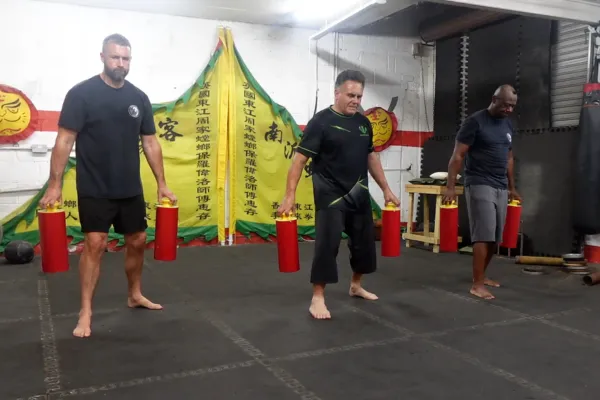
In Okinawan Goju-Ryu Karate, one of the oldest strength tools is the Nigiri Game — heavy clay jars with wide rims that are gripped by the fingertips and lifted while moving through stances. The jars are often filled with sand, stones, or water to increase weight. The practitioner holds one in each hand, squeezing the rim while walking in Sanchin-dachi or Shiko-dachi stance.
This simple exercise forges incredible grip strength and tendon resilience. It also connects the hands to the core — every step, breath, and contraction works together. The result isn’t just stronger fingers, but a more integrated, rooted structure. Old Okinawan masters would say that the hands must be “alive” — full of energy and ready to grip, strike, or block without hesitation.
The beauty of the clay jar training lies in its simplicity. The jars require constant tension from the fingertips to prevent them from slipping. Over time, this creates dense tendons, thickened ligaments, and a crushing grip. The exercise doesn’t just build strength—it develops endurance, posture, and stability through every part of the body.
The Shaolin Way – Iron Fingers of the Temple
At the Shaolin Temple, Iron Finger training was part of the legendary 72 Arts of Shaolin. The monks believed the fingers should be as strong and precise as a spear. Their training began with a box of beans. Every day, monks would stab their fingertips into the beans, hundreds of times. Once their fingers adapted, they would replace the beans with gravel, then sand, and finally iron shot.
This progressive overload hardened the skin, thickened the bones, and conditioned the tendons to withstand impact. In some variations, monks would strike sandbags with extended fingers, or thrust their hands into bundles of bamboo. Others practiced pulling nails from wooden boards using only three fingers — thumb, index, and middle — to build gripping strength for locking and tearing techniques.
To outsiders, these methods look extreme, even brutal. But behind the pain was purpose. Shaolin finger training wasn’t about damage—it was about control. The fingers were trained to deliver precision strikes to pressure points (Dian Xue), to grip or break joints, and to maintain structure when applying power.
The monks also combined Iron Finger training with internal breathing exercises and Chi Gung (energy cultivation), ensuring that the energy of the body flowed freely into the hands. Over time, this created a deep, connected strength — not just in muscle, but in spirit.
The Southern Mantis Approach – The Iron Dragon Claw
In the Hakka tradition of Southern Praying Mantis Kung Fu, the hands are the soul of combat. Every movement, from blocking to striking, relies on close-range contact, trapping, and shock power. To achieve this, Chow Gar practitioners developed their own version of Iron Finger training — the Iron Dragon Claw.
This training focuses on the claw-like grip used to seize, twist, or crush. Students begin with sand-bucket drills: plunging the fingers into coarse sand, gripping and twisting repeatedly to strengthen every joint. Over time, the sand is replaced with gravel and finally iron shot. Each stage teaches the fingers to adapt to harder resistance.
Fingertip push-ups are another core drill — first on the knees, then full-body, and eventually on one or two fingers. The goal isn’t to perform a trick; it’s to develop tendon strength and structural integrity throughout the hands and arms.
Advanced students move on to hanging drills, gripping ropes or poles using only the fingertips, and striking wooden stakes with the claw hand. These exercises build impact tolerance and reinforce the Mantis hand’s explosive “short power.”
The Chow Gar system believes that strong fingers and hands allow you to project power through small movements. When you can grip and control with the fingertips, you don’t need big, looping strikes. Every inch of motion becomes a potential weapon.
The Shared Principles
Although the tools and methods differ, Goju-Ryu, Shaolin, and Chow Gar all follow the same fundamental principles of Iron Finger training:
Progressive Resistance: Start soft, build gradually. From beans to sand, from light jars to heavy, the body adapts safely.
Structural Alignment: The power of the fingers must come from the body, not isolated muscle effort. Good stance and posture ensure the energy travels from the legs through the core to the fingertips.
Internal and External Balance: Strength without control is useless. Each system pairs physical conditioning with breathing and mental focus, developing internal calm to match external power.
Durability and Protection: The ultimate goal is to strike or grip without self-injury. Through repeated adaptation, the fingers become resilient, shock-absorbent, and dependable.
Discipline and Patience: Iron Finger training is slow and uncomfortable. It tests character as much as it builds strength. The hands toughen, but so does the mind.
Practical Benefits
Beyond the legendary stories, Iron Finger training offers tangible benefits for modern martial artists:
Grip Power: Stronger fingers improve weapon control, clinching, and grappling.
Structural Integrity: Reinforces the chain of strength from fingers to shoulders.
Tendon Health: Strengthens connective tissue often neglected in modern workouts.
Impact Resistance: Reduces the risk of sprains and fractures during striking.
Mental Fortitude: Builds focus, patience, and persistence through slow, steady progress.
Training Tips for Modern Practitioners
If you’re interested in exploring Iron Finger training safely, start slow. Begin with fingertip push-ups on soft mats or a wall. Try light sand-bucket drills, focusing on form, not speed. Over time, increase resistance — switch to gravel, add weight to your jars, or extend your hold time.
Always warm up your hands and wrists before training, and stretch afterward. Tendons and joints adapt slowly, so never rush. Remember: pain is a signal, not a badge of honour. Proper recovery and balanced training will prevent long-term damage.
It’s also valuable to integrate your hand conditioning with your martial forms. In Chow Gar, for example, the Sarm Bo Jin form develops internal strength and structure that supports Iron Finger training. When your stance, breath, and intent are aligned, your grip becomes more than muscle—it becomes expression of energy.
The Deeper Meaning
Iron Finger training isn’t just physical—it’s symbolic. The slow, repetitive, often painful work represents the spirit of Kung Fu itself: patience, persistence, and transformation through discipline. Each thrust into the sand, each grip of the jar, each fingertip push-up is a reminder that true power comes from consistent effort over time.
In the end, Iron Finger training teaches us that strength isn’t loud or flashy. It’s silent, steady, and earned. When your fingers become strong, your mind follows. You learn to control tension, to move with precision, and to strike with intent.
This is why masters across generations—whether from Okinawa, the Shaolin Temple, or the Hakka villages of Southern China—all came to the same truth: if the hands are weak, the art is weak. But when the hands are forged through fire, the whole body becomes unbreakable.
So, the next time you train, look at your hands. Are they soft, or are they ready? The path of the Iron Finger may not be easy, but for those who walk it, it builds more than strength—it builds spirit. True Kung Fu power begins at your fingertips.