New Blog Post
Quick Answer
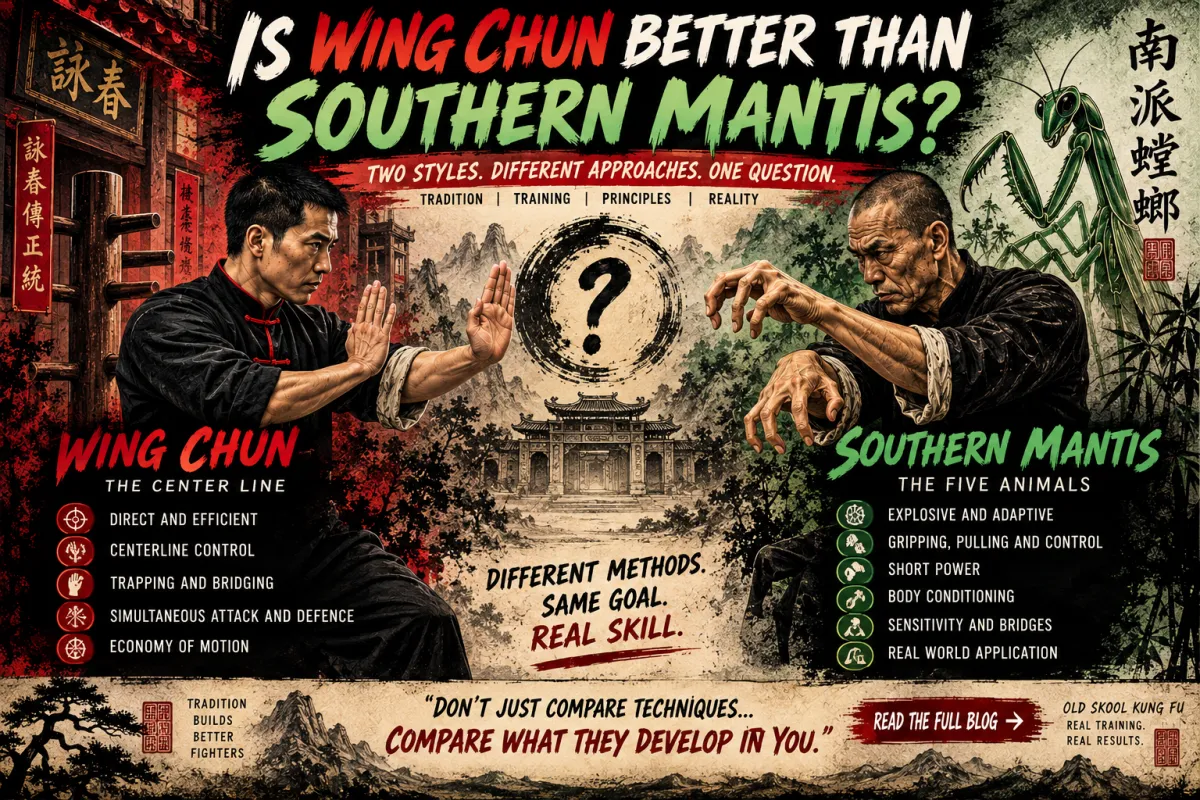
No, neither one is better. They are two different answers to the same close-range problem.
Wing Chun is built around structure. Hold the centreline, stay relaxed, use economy of movement, and let trained sensitivity in the arms tell you where your opponent is going. Most of the work is drilling that structure until it becomes reflex.
Chow Gar Southern Praying Mantis works at the same distance but gets there another way. It is built on conditioning the body, developing short explosive power from a sunk and connected frame, and chi gung to drive it. Much of the work is physical and involves real contact with a partner.
The aim is not to decide which style would win.
The useful question is which kind of training you would still be turning up for in three years' time, because that is what actually decides how good you get.
The first thing to establish is what each system is really asking of you in the training hall.
What does Wing Chun training normally involve?
Wing Chun is a close-range southern system organised around a small number of very deliberate ideas. It is known for being efficient rather than athletic, which is part of why it has spread so widely.
That can include:
Centreline theory, attacking and defending along the shortest line
Forms such as Siu Nim Tau, Chum Kiu and Biu Jee
Chi sau, or sticking hands, for sensitivity through contact at the forearms
The wooden dummy, for angle, position and repetition
Straight-line punching
Simultaneous attack and defence
Structure and alignment rather than strength
Done well it is precise, economical and very quick at short range.
The emphasis is on doing less, but doing it in exactly the right place.
Does Southern Mantis train in the same way?
Not really, although the two systems do share some ground.
Chow Gar Southern Praying Mantis also fights close, also uses bridging, and also relies on feeling an opponent through contact rather than watching them. That is where the similarity ends.
The training normally involves:
Body conditioning, so that contact is not a shock
Chi gung trained as power development, not relaxation
Short explosive power generated from a sunk frame, the elbows and the back
Phoenix eye fist and other small, penetrating hand shapes
Bridging and sticking drills done under real pressure
Footwork and structure trained with a partner leaning on you
Pad work, application and power training in every session
The system is often described as old skool because the method has not been softened for a modern fitness market.
It is close, it is physical, and it takes some getting used to.
Why do people think the two are similar?
Because on the surface they share a lot.
Both are southern Chinese systems. Both work inside the range where most real trouble actually happens. Both use the forearms to feel what an opponent is doing. Both use short, direct hands instead of big swinging attacks.
Watch two clips back to back and you would be forgiven for thinking they are cousins.
The difference is underneath. Wing Chun tends to solve the problem with position and relaxation. Southern Mantis tends to solve it with structure, conditioning and power.
One is trying to be in the right place. The other is trying to be immovable in the wrong one.
How does the training actually differ day to day?
This is the part most people never consider before they join a school, and it is usually the part that decides whether they stay.
In a Wing Chun class you can generally expect:
An emphasis on structure, position and economy of motion
Drills at light to moderate contact
Power built through alignment and relaxation
A physical demand most people can meet from day one
Progress that looks like cleaner structure and faster reactions
In a Chow Gar class you can generally expect:
An emphasis on conditioning, connected power and pressure
Firm and constant contact, because contact is the lesson
Power built from a sunk frame, the elbows, the back and chi gung
A physical demand that takes a few weeks to get used to
Progress that looks like a body able to take and deliver more
Neither of those is wrong. They simply attract different people, and they suit different reasons for training.
Which one is better for self-defence?
Any honest answer has to start with the same point: the instructor and the training method matter far more than the style name above the door.
A well-taught Wing Chun class with real pressure testing will beat a lazy Mantis class every time, and the reverse is just as true.
A few simple questions tell you more than the style name ever will:
Do you regularly train against someone who is genuinely resisting?
Have you ever been hit, and learned to keep working anyway?
Can the instructor do what they are teaching, not just explain it?
Does the conditioning match what you are asking your body to do?
How long have you actually stuck at it?
Where Southern Mantis has an advantage is that resistance and contact are not an optional extra for advanced students. They are there in the first lesson, because the system does not really function without them.
So which one should you train?
Pick the one that matches what you actually want from it.
Wing Chun is a good fit if you are drawn to precision, structure and problem-solving, and you would rather refine a small toolkit than build a hard body.
Southern Praying Mantis is a better fit if you want the training itself to change you physically, if you like the idea of conditioning, close contact and old-fashioned hard graft, and you are not looking for a gentle hour in a leisure centre.
The most reliable test is not reading about it. It is standing in the hall, putting your arm on someone else's, and finding out whether you like the feeling.