Why Should You Condition Your Hands for Kung Fu?
Training & Conditioning
Why Should You Condition Your Hands for Kung Fu?
Quick Answer
Because your hands are your weapons. A weapon that breaks the first time you use it is no weapon at all.
Conditioning makes your hands, wrists and fingers harder and stronger, so you hit like a sledgehammer and damage your opponent instead of yourself.
You don’t have to go mad. You just have to do it consistently: bare-knuckle pad work, the iron dragon jars and a handful of other old skool exercises.
Walk into most martial arts clubs and you’ll see the same thing: gloves on, wraps on, a few pads, a lot of punching the air. Everyone looks the part.
But ask a simple question: what happens when you hit something hard without the gloves? For most people, the honest answer is that they don’t know. And a real fight is a bad place to find out.
Why Are Your Hands Your Weapons?
In kung fu, your hands strike, grab, trap and control. Everything goes through them. So the harder and stronger you make them, the harder you hit.
Think of it like tools in a toolbox. Nobody would drive a nail with a plastic hammer. The same is true of your fist: if the tool is soft, the job doesn’t get done.
What Happens If You Don’t Condition Your Hands?
Punch someone with an unconditioned hand and one of two things tends to happen:
Your wrist folds. If it isn’t strong enough to take the impact, it bends on contact and you can injure it.
Your hand breaks. The small bones in the hand aren’t built for impact until you train them for it.
Either way, the fight you were trying to end just got a lot harder, because now you’re fighting one-handed.
Aren’t Gloves and Wraps Enough?
Gloves and wraps protect your hands in training. That’s fine for what they are, but they don’t strengthen anything.
In a real situation, nobody gives you time to put your wraps on.
Hitting pads in gloves trains your timing, not your hands.
If the gloves do all the protecting, your hands never learn to protect themselves.
This is the difference between looking the part and training the part.
Why Does Grip Strength Matter So Much?
Striking is only half the story. In Mantis we grab, pull and control, and for that you need a powerful grip. We call it the eagle claw grip.
Look at people whose grip is naturally powerful:
Judo players have powerful grips because they spend every session grabbing each other.
Rock climbers have incredibly strong fingers because they use them to pull their whole body up a wall.
Neither of them got that grip from a gym machine. They got it from using their hands, over and over, for years. That’s exactly how conditioning works.
What’s the Difference Between a McDojo and Old Skool Training?
McDojo: gloves on, a few pads, punching the air, a new belt every few months. It looks good and it feels good, but the hands underneath stay soft.
Old skool: conditioning is part of every week. Not because it’s tough for the sake of it, but because a martial art that can’t hit hard isn’t really a martial art.
When you hit someone, the idea is that you hit them like a sledgehammer. You’re not going to damage yourself. You’re going to damage your opponent.
How Do We Condition Our Hands?
Our approach is simple: steady, sensible and consistent.
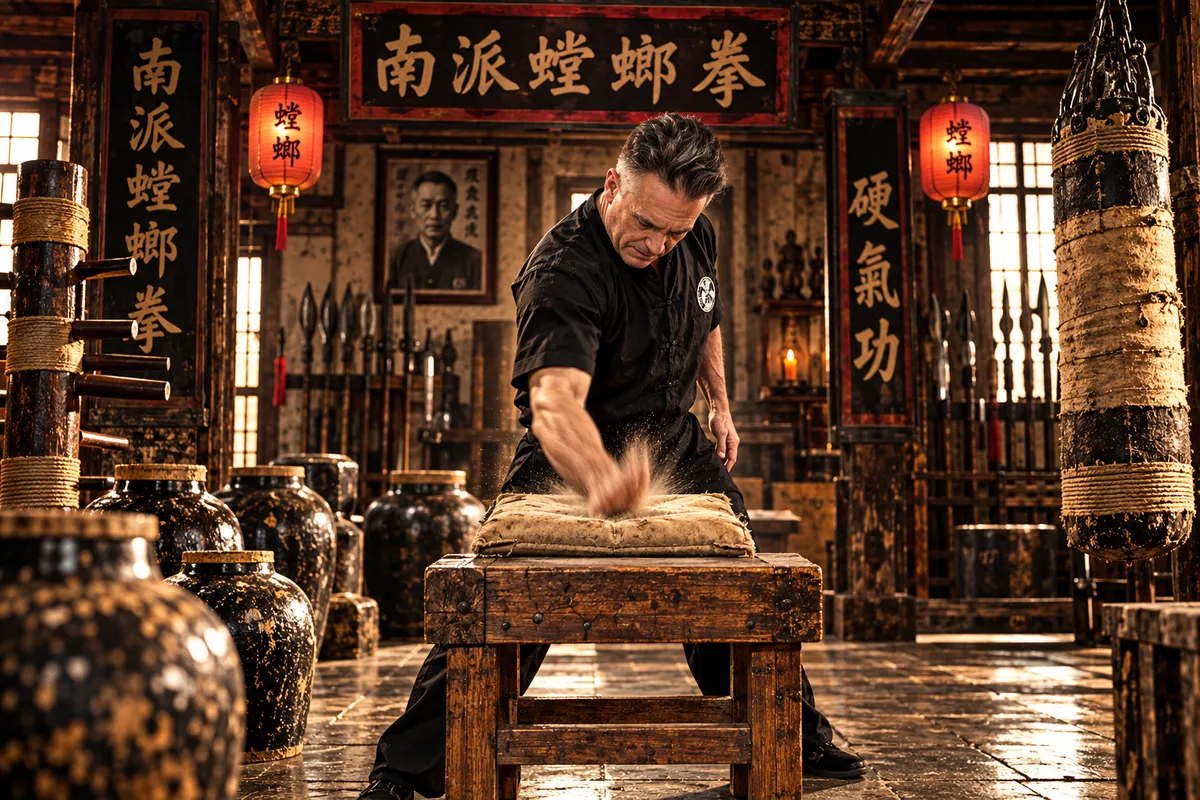
Bare-knuckle pad work. Hitting the pads with no gloves on is a great start. Your hands, wrists and forearms slowly get used to real impact.
The iron dragon jars. Gripping and lifting weighted jars builds finger power, grip and wrist strength, the foundation of the eagle claw.
Conditioning bags and other traditional exercises, built up gradually over time.
Dit da jow, the traditional liniment rubbed in after conditioning to look after your hands.
Do You Have to Smash Your Hands to Pieces?
No. This is the part people get wrong. Conditioning isn’t about pain or bravado.
You don’t have to go mad. Start light and build up over months and years.
Consistency beats intensity. A little, often, is what changes your hands.
Good conditioning makes you stronger, not damaged. If it’s injuring you, it’s being done wrong.
So, Why Condition Your Hands?
Your hands are your weapons, so they need to be strong.
Strong hands and wrists hit harder and don’t break on contact.
A powerful grip lets you grab and control, not just strike.
Gloves protect your hands, but only conditioning strengthens them.
Train the part, don’t just look it. That’s old skool.
ST